Disclaimer: This article is intended for general informational and educational purposes only. The content reflects publicly reported events, regulatory discussions, and broader industry trends relating to artificial intelligence use in professional environments.
The examples referenced — including matters involving financial institutions, legal professionals, and consulting firms — are discussed to illustrate broader governance and workplace risks associated with emerging technologies. They should not be interpreted as definitive findings of wrongdoing beyond what has been publicly reported by courts, regulators, or credible media sources.
The author does not make any allegations against specific individuals or organizations and does not claim access to confidential or non-public information. Any reference to companies, institutions, or professional bodies is solely for contextual discussion of industry-wide issues related to AI governance, professional responsibility, and compliance.
Readers should not rely on this article as legal, financial, regulatory, or professional advice. Organizations and individuals should seek appropriate qualified professionals when making decisions relating to AI adoption, compliance, or professional conduct.
The views expressed are those of the authors alone and do not necessarily reflect the views of any employer, affiliated organization, or institution.
Artificial intelligence has moved from novelty to necessity in many modern workplaces.
From drafting reports to analyzing data, tools such as generative AI systems are increasingly integrated into daily workflows.
Used correctly, they can dramatically increase productivity and improve decision-making.
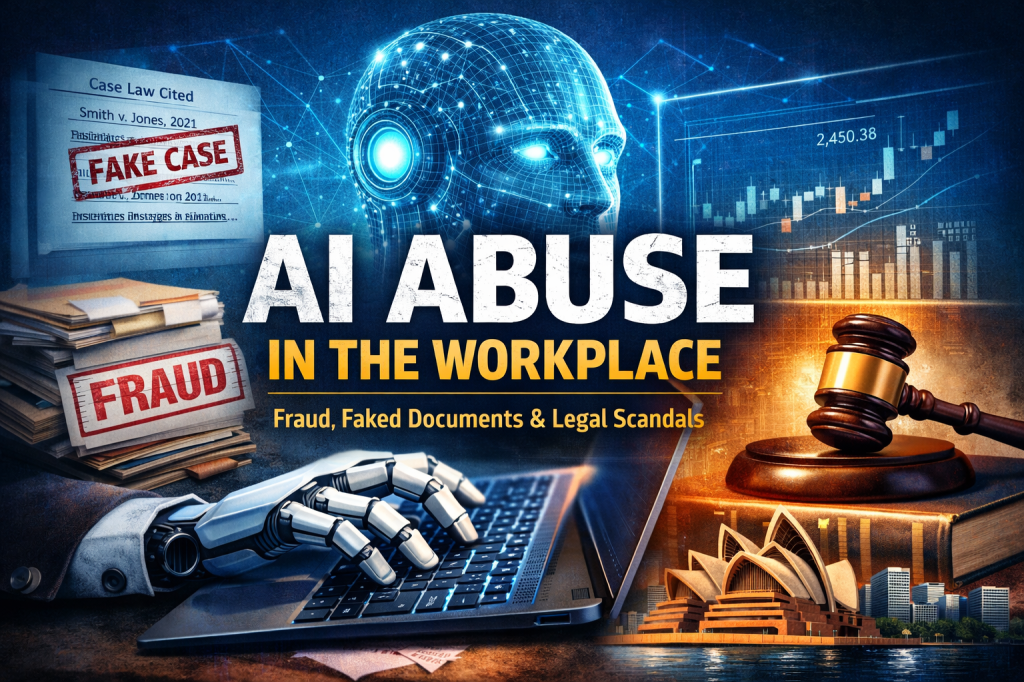
However, a growing number of high-profile cases show a darker side: AI abuse in professional environments.
Employees, consultants, and even senior executives are using AI tools irresponsibly by fabricating information, bypassing compliance controls, or delegating professional judgment to systems that were never designed to replace it.
The result is not just embarrassing mistakes.
In some cases it has led to fraud investigations, legal sanctions, professional licence suspensions, and regulatory penalties.
This article examines how AI abuse is emerging across industries and why governance has not kept pace.
1) What “AI Abuse” in the Workplace Actually Means?
AI abuse is not simply using AI incorrectly.
It refers to situations where AI tools are used in ways that violate professional standards, regulatory obligations, or ethical responsibilities.
Common forms include:
Fabricated Information (AI Hallucinations)
Employees submit AI-generated outputs without verifying facts, leading to fabricated citations, incorrect financial analysis, or invented laws.
Delegation of Professional Judgment
Professionals rely on AI to perform tasks that legally require human expertise, such as legal reasoning, financial advice, or engineering decisions.
Circumventing Internal Controls
Employees use AI to generate documents or analysis that bypass formal review or quality systems.
Fraud and Manipulation
AI tools can be used to fabricate supporting documentation, generate fake communications, or automate deceptive activities.
While these risks were initially theoretical, several recent cases demonstrate how real and damaging they can be.
2) Banking Sector: Fraud and AI Manipulation at Commonwealth Bank
One of the most concerning emerging risks is the use of AI tools within financial institutions.
In Australia, the Commonwealth Bank of Australia (CBA) has been involved in investigations related to fraudulent activity linked to internal systems and digital automation tools.
While not always solely caused by AI, emerging reports and internal compliance concerns highlight how AI-generated material can be used to manipulate processes such as documentation, approvals, and communications.
How AI Can Enable Financial Misconduct
Within banking environments, AI tools can be misused to:
- Generate fabricated supporting documentation for transactions
- Create convincing internal communications or approvals
- Produce synthetic financial analyses
- Automate fraudulent requests or scripts
Financial institutions rely heavily on documentation trails and internal review.
When AI is used to generate convincing but false material, it can weaken the reliability of these controls.
Banks worldwide are now strengthening AI governance frameworks, requiring employees to disclose when AI is used in producing work products.
The key risk is simple:
AI can produce something that looks professional but is completely incorrect or fabricated.
In finance, that can quickly escalate into fraud.
3) Legal Profession: Lawyers Losing Their Licenses Over AI
The legal industry has already seen some of the most visible consequences of AI misuse.
Several lawyers internationally have faced disciplinary action after submitting court documents containing AI-generated fake cases.
The “Hallucinated Case Law” Problem
Generative AI models can produce citations that appear legitimate but do not exist. These fabricated references are called hallucinations.
In multiple court cases, lawyers relied on AI tools to prepare legal submissions without verifying sources. The filings included:
- Non-existent legal precedents
- Fabricated case citations
- Incorrect judicial interpretations
Courts quickly identified the errors, and the consequences were severe.
Consequences Observed
Lawyers have faced:
- Court sanctions
- Professional disciplinary proceedings
- Fines
- Suspension or loss of legal licences
Judges have explicitly warned that AI cannot replace a lawyer’s professional duty to verify legal authorities.
The legal profession operates on trust in citations and precedent.
Once AI introduces fabricated material into that system, it undermines the integrity of legal proceedings.
4) Consulting Industry: KPMG Directors Fined for AI Misconduct
Professional consulting firms are also confronting the risks of AI misuse.
In Australia, several KPMG directors were fined after regulatory findings related to improper conduct involving automated tools and internal systems.
While not purely an AI issue, the case highlighted how technology-assisted shortcuts can undermine professional obligations.
Consulting firms operate in environments where:
- Expert advice is sold as professional judgment
- Clients assume rigorous analysis and verification
- Regulatory compliance is critical
If AI is used to generate reports, analyses, or advisory content without proper validation, the risks include:
- Misleading clients
- Producing flawed risk assessments
- Delivering advice based on fabricated data or reasoning
Regulators are increasingly scrutinizing how firms integrate AI into advisory work.
For consulting professionals, the message is clear:
AI cannot replace the duty of care owed to clients.
5) Why AI Misuse Is Increasing in Workplaces?
AI abuse is not primarily caused by malicious intent.
More often, it arises from a combination of productivity pressure, overconfidence in technology, and lack of governance.
Several structural factors are accelerating the problem.
Productivity Pressure
Employees are encouraged to “work smarter” and deliver outputs faster.
AI tools promise instant results, creating temptation to rely on them without proper verification.
Overconfidence in AI Accuracy
Many users assume AI systems function like search engines or databases.
In reality, generative AI models predict text patterns, which means they can produce confident but incorrect information.
Lack of AI Policies
Many organizations adopted AI tools before establishing internal policies governing their use.
Employees may not understand:
- When AI use is allowed
- What tasks require human verification
- What documentation standards must be maintained
Invisible AI Use
Unlike traditional software tools, AI use is often invisible in the final output.
A report written with AI may appear identical to one written by a human expert.
Without disclosure policies, misuse can go unnoticed until errors surface.
6) The Professional Responsibility Problem
At its core, AI misuse in the workplace is a professional accountability issue.
Most regulated professions operate under principles such as:
- Duty of care
- Verification of information
- Independent judgment
- Professional competence
AI tools challenge these responsibilities because they can generate outputs that appear authoritative but lack any verification.
Professionals remain legally responsible for their work—even if AI generated it.
This principle has been reinforced repeatedly in regulatory responses.
Courts, regulators, and professional bodies have consistently stated:
Using AI does not reduce professional accountability.
7) Emerging Regulatory Responses
Governments and regulators are beginning to respond to AI risks in professional settings.
Key emerging approaches include:
Mandatory AI Disclosure
Employees must disclose when AI tools are used in producing work.
Verification Requirements
Outputs generated by AI must be independently verified before use.
Restricted Use Cases
Certain tasks such as legal advice or financial analysis, may require human authorship.
AI Governance Frameworks
Organizations must document how AI tools are deployed and monitored.
For example, Australia, the US, and the EU are all moving toward formal AI governance standards for regulated industries.
8) The Future Workplace: AI as a Tool, Not a Substitute
Artificial intelligence will undoubtedly become a permanent feature of the workplace.
The technology offers enormous productivity potential when used responsibly.
However, the early wave of incidents from banking concerns to legal sanctions and consulting penalties has demonstrated a fundamental lesson:
AI cannot replace professional judgment.
Organizations that succeed in integrating AI will not be those that automate expertise away.
Instead, they will be those that treat AI as a support tool within strong governance frameworks.
The challenge ahead is not technological… it is cultural.
Employees must learn that while AI can generate answers instantly, responsibility for those answers still belongs to the human who submits them.
Conclusion
The rise of AI in the workplace has introduced a new category of professional risk:
AI-enabled misconduct.
From financial fraud concerns in banking to lawyers submitting fabricated case law and consulting executives facing regulatory penalties, the message from regulators is becoming clear.
AI does not eliminate professional responsibility.
In fact, as these cases show, it may increase it.
Organizations that fail to establish strong AI governance frameworks risk more than operational mistakes.
They risk regulatory action, reputational damage, and loss of public trust.
The future of AI at work will not be defined by how powerful the technology becomes.
It will be defined by how responsibly humans choose to use it.
The next article that involves AI will be a collaboration article between Ashneil, Wilson, and Eddy. This article will be the examination of AI’s responses to the same question sets, and evaluation of which AI is best suited for what purpose.
Authors Note: Eddy Xu and Ashneil Shankar also known as user name ashneilshanker16 are trying to use their recent experiences of AI and enlightenment with how easy artificial intelligence has made workplaces become a double edged sword in delivering questionable outcomes. This is an opinion article as they try bring awareness to the wider world that dependence with AI requires strong discipline and proper governance.
 DeepDivers
Leave a comment