
Image by Allexxandar on Freepik
The first of the alkaline earth metals Beryllium will be closely examined to determine the practicality and further applications that it can contribute to the future of sustainability.
What is Beryllium?
Beryllium is an alkaline earth silvery-white soft and low dense metal that was discovered in 1798 by the French chemist Louise Nicolas Vauquelin in its mineral form [1][6]. Beryllium oxide was found to be ‘sweet’ hence was named according to the Greek word ‘glykys’ called glaucinium [6][8]. However, the mineral form called Beryl was a more popular name in the scientific community and has now become the official name [1][2].
The isolation of the element was done in 1828 by a French and German chemists , Antoine Bussy and Friedrich Wohler respectively [6]. The experiment for the isolation of Beryllium involved the use of reacting Beryllium oxide with Potassium [1].
Although Beryllium has many uses within the different industries, the safety handling protocols for Berryllium is important for health [3]. The metal and its mineral state are a carcinogenic toxin that can lead to an incurable inflammation of the lungs called Berylliosis [2][4].
Berylliosis is an immune system response where the lungs become heavily inflamed by the presence of Beryllium which causes scarring and a reduction in lung capacity for the host [2][4]. As stated before, there is no cure for this disease, which makes this quite a severe and potentially fatal consequence if Beryllium was not handled properly by operators in the industry [5].
Current applications of Beryllium?
Although Beryllium possesses dangerous properties that could impact a person’s health, they have several properties such as thermal, electrical, and anti-corrosive properties [2][7]. This has made it useful for the aerospace, defence, medical, and other sectors [6].
- Aerospace and Defence Sectors

Beryllium can be used in creating an alloy agent with Copper (BeCu) and Nickel (NiBe) [8]. These alloys are then used to create mechanical and electrical components used for the vital construction and maintenance of aircraft, spacecraft, and rocketcraft [2][9]. As such the defence industry, especially the army organisations, value the use of Beryllium as they can be used to make the necessary equipment for the defence of their respective national governments [3].
- Medical Sectors

Beryllium metal and Beryllium oxide (BeO) are used in the applications of X-rays due to the property of being transparent [6][8]. The high electrical conductivity properties allows beryllium metal and oxides to be used as great electrical components due to their insulation to high heat generation [8]. Such medical devices would be surgical instruments, monitoring appliances, and analytical equipment [8]. Additionally, cancer therapeutic equipment would also be affected due to the specific uses that require high-end electrical components needed to find specific symptoms from patients [3][9].
- Minor Sectors
Beryllium metal compounds have been used as catalysts to help manufacture glass which has been proven to be very useful. Beryllium metal has also been used in nuclear reactors [2].
Due to the non-sparking and non-magnetic nature of Beryllium alloys, they have been useful in creating tools for high explosion risk environments like mining where methane gas is present [3]. Due to the risk of berylliosis, alternative hammers like copper or bronze has been used in mining as they also produce no sparks [6][9].
Current Methods of extracting Beryllium
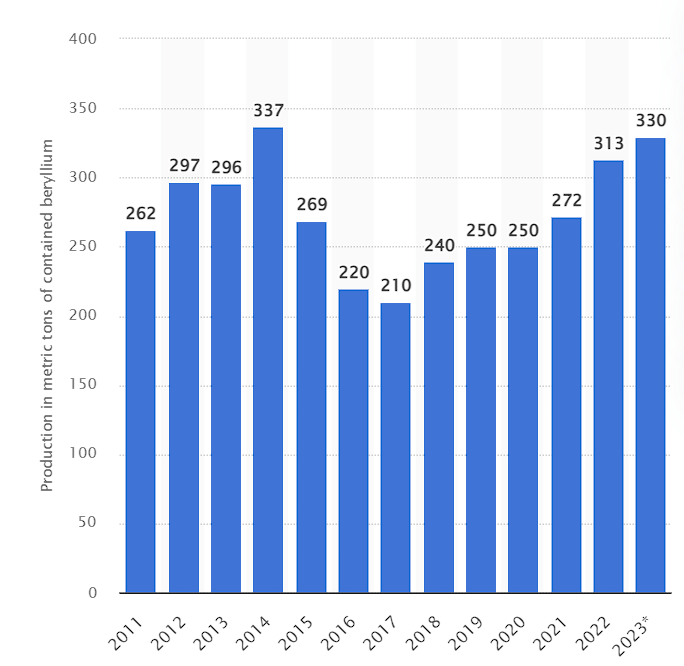
The current global supply of Beryllium to be dated from 2022 to 2023 was approximately 330 metric tons [10]. United States of America was the largest producer, followed by China and Russia [6]. The recent development of arms in the defence sector may have been one of the major underlying motives behind the increase of production of the toxic metal Berryllium.
Beryllium produced using a conventional method of ingot casting at high temperatures could form compounds with the materials around the cast ingot causing impurities in the finished product.
To reduce the loss of purity in Beryllium, a popular alternative method involves using Beryllium powder in a vacuum at high temperatures [11]. This creates a vacuum hot-pressed (VHP) block which can be further processed to higher purity or to different purposes [11][13]. This powder metallurgy method has been relied on, compared to the conventional method of ingot casting [11].
Global Supply of Beryllium
The raw material to create the refined Beryllium chemically and physically, originates from two common types of ores. They are bertrandite ore, and beryl ore which accounts for 90% and 10% of the world’s current supply [7].
Bertrandite ore exists as a colourless to pale yellow crystal. The ore undergoes complex chemical processing to extract the beryllium compounds, such as acid leaching and precipitation steps [7].
Whereas Beryl ore [7] is typically obtained as a byproduct from the mining of other deposits.
What now?
Contrary to the strong belief that Beryllium poses as a toxic and carcinogenic source of harm to human health and safety, the continued production of this element in its compound state shows that this element has strong applications to the functioning of society [12].
As such, Beryllium has been considered to have very high costs of regulations and risks in order to adhere to sustainable policies and would continue to be revised in determining the best protocols for safety to humans.
Bibliography
[1] T. P. Hanusa, “Beryllium | chemical element,” Encyclopædia Britannica. Britannica.com, May 15, 2024. Accessed: Jun. 16, 2024. [Online]. Available: https://www.britannica.com/science/beryllium
[2] A. Blaszczak-Boxe, “Facts About Beryllium,” Live Science, Oct. 07, 2017. https://www.livescience.com/28641-beryllium.html (accessed Jun. 16, 2024).
[3] U.S. Department of Labour, “Beryllium – Overview | Occupational Safety and Health Administration,” http://www.osha.gov, 2024. https://www.osha.gov/beryllium (accessed Jun. 16, 2024).
[4] NORD, “Berylliosis,” NORD (National Organization for Rare Disorders), Apr. 07, 2009. https://rarediseases.org/rare-diseases/berylliosis/ (accessed Jun. 16, 2024).
[5] Cleveland Clinic, “Beryllium Disease,” Cleveland Clinic, Mar. 12, 2024. https://my.clevelandclinic.org/health/diseases/13807-beryllium-disease (accessed Jun. 16, 2024).
[6] Royal Society Of Chemistry, “Beryllium,” Rsc.org, 2024. https://www.rsc.org/periodic-table/element/4/beryllium (accessed Jun. 16, 2024).
[7] Office of Environment, Health, Safety & Security, “About Beryllium,” Energy.gov. https://www.energy.gov/ehss/about-beryllium (accessed Jun. 16, 2024).
[8] AZO Materials, “Beryllium (Be) – Properties, Applications,” AZoM.com, Jun. 04, 2013. https://www.azom.com/article.aspx?ArticleID=9095 (accessed Jun. 16, 2024).
[9] The Beryllium Science & Technology Association, “About Beryllium,” BeST, 2016. https://www.beryllium.eu/uses-benefits-critical-applications (accessed Jun. 16, 2024).
[10] M. Jaganmohan, “Production of beryllium worldwide from 2011 to 2023,” Statista, Jun. 03, 2024. https://www.statista.com/statistics/802034/production-of-beryllium-worldwide/ (accessed Jun. 16, 2024).
[11] A. Goldberg, “Beryllium Manufacturing Processes,” http://www.osti.gov, Jun. 2006, doi: https://doi.org/10.2172/897931.
[12] Minerals Education Coalition, “Beryllium,” Minerals Education Coalition, 2024. https://mineralseducationcoalition.org/minerals-database/beryllium/ (accessed Jun. 16, 2024).
[13] Special Metals, “The Environmental Impact of Beryllium Copper Wire Production and Usage,” Special Metals, Apr. 11, 2024. https://www.smalloys.com/blog/the-environmental-impact-of-beryllium-copper-wire-production-and-usage/ (accessed May 19, 2024).
 DeepDivers
Leave a comment