
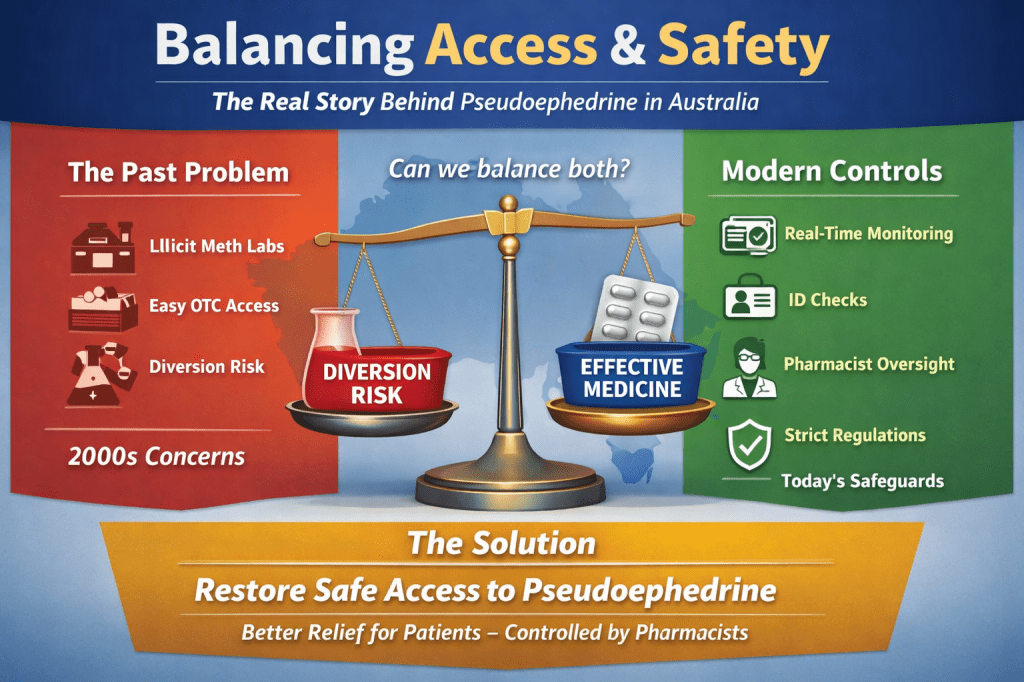
Continuing on from the previous article.
Pseudoephedrine (PSE) didn’t disappear from Australian pharmacy shelves because it stopped working.
It disappeared because of how it could be misused.
Nearly two decades later, with vastly improved pharmacy controls and monitoring systems, it is worth asking a critical question:
“Are we still regulating pseudoephedrine based on today’s evidence or yesterday’s risks?”
Why pseudoephedrine became restricted in Australia?
In the early to mid-2000s, Australia experienced a sharp rise in domestic methamphetamine production. [1]
Pseudoephedrine (PSE), a well-established oral nasal decongestant, was identified as a key precursor chemical used in small-scale illicit synthesis. [2]
In response, Australian governments introduced escalating controls, including:
- Re-scheduling PSE-based products
- Moving products behind the pharmacy counter
- Limiting pack sizes and total pseudoephedrine content
- Requiring pharmacist assessment and purchaser identification
These measures aligned with international findings that retail access to precursor medicines contributed to clandestine drug manufacture. [3, 4]
Importantly, these restrictions were risk-based public-health interventions, not reflections of concerns about pseudoephedrine’s therapeutic effectiveness.
Real-time monitoring systems: a structural shift
A defining development in Australia’s response was the rollout of real-time electronic pseudoephedrine sales monitoring, most notably Project STOP, implemented nationally through community pharmacy. [5]
Project STOP enables:
- Immediate recording of every pseudoephedrine transaction
- Identification of suspicious purchasing behaviour across pharmacies
- Pharmacist refusal of supply where diversion risk is detected
- Secure data sharing with law-enforcement agencies under legislative authority
Evaluations by Australian and international agencies show that real-time electronic monitoring significantly reduces pharmacy-based diversions and “smurfing” behaviours compared with pack-size restrictions alone. [6, 7]
Crucially, these systems were not in place at scale when pseudoephedrine was first restricted.
What changed and what didn’t?
| What changed? | What didn’t change? |
| – Pharmacy digital infrastructure – Mandatory sales recording and audit trails – Pharmacist training in diversion detection – Inter-agency data sharing – Regulatory compliance oversight | – Pseudoephedrine’s pharmacology – Its proven effectiveness as an oral decongestant – Its predictable safety profile when supplied appropriately |
Clinical pharmacology literature consistently demonstrates that pseudoephedrine has good oral bioavailability and produces significant reductions in nasal airway resistance. [8, 9]
Adverse effects such as insomnia or mild cardiovascular stimulation are well characterised and manageable through pharmacist screening. [10]
In short, the risk-management environment evolved dramatically, while the medicine itself remained unchanged.
The unintended consequence: efficacy was deprioritised
As access to pseudoephedrine tightened, manufacturers increasingly reformulated products with oral phenylephrine (PE) to maintain open-shelf availability.
However, multiple controlled studies and systematic reviews have shown that oral phenylephrine, at standard OTC doses, provides little or no clinically meaningful relief of nasal congestion compared with placebo. [11, 12, 13]
This led the U.S. FDA Non-prescription Drugs Advisory Committee in 2023 to unanimously conclude that oral phenylephrine is ineffective as a nasal decongestant. [14]
The result:
- Diversion risk was reduced
- But therapeutic effectiveness for nasal congestion declined
From a policy perspective, this trade-off warrants re-examination.
Safety is not binary, it is managed
Modern medicines regulation recognises that safety exists on a spectrum and is achieved through layered controls:
- Scheduling under the Poisons Standard (SUSMP)
- Professional oversight by trained pharmacists
- Pack-size and dosage limits
- Mandatory electronic monitoring and audit
Pseudoephedrine already fits squarely within this framework. Under Australia’s national scheduling system administered by the Therapeutic Goods Administration (TGA), pseudoephedrine is classified as a Pharmacist-Only or Prescription-Only medicine depending on formulation. [15]
This places pseudoephedrine alongside other medicines with recognised misuse potential (including opioids, benzodiazepines, and stimulant therapies) which remain available because their clinical value justifies controlled access.
Restriction should not mean exclusion
International experience supports this approach. The United Kingdom, Canada, and several European jurisdictions continue to allow pharmacist-controlled access to pseudoephedrine while maintaining strict precursor-control frameworks. [16, 17]
Evaluations consistently demonstrate that professional gatekeeping combined with electronic monitoring is more effective than outright exclusion.
With over 20 years’ experience working on pseudoephedrine-containing products in Australia, I’ve seen these systems operate effectively in real-world pharmacy environments delivering patient benefit without compromising public safety.
Why the conversation needs to reopen?
We now have:
- Strong evidence questioning phenylephrine’s effectiveness
- Mature, audited pharmacy monitoring systems
- Highly trained pharmacists capable of clinical risk assessment
- Longstanding experience managing pseudoephedrine responsibly
What’s missing is not infrastructure or data, it’s a policy recalibration aligned with current capabilities rather than historic limitations.
Closing thought
Pseudoephedrine was never restricted because it failed patients. It was restricted because systems weren’t ready to manage diversion risk. Today, those systems exist — and they work.
The question is no longer “Is pseudoephedrine risky?”
It is “Can modern pharmacy controls allow us to safely restore access to a medicine that actually works?”
In the next article, I’ll examine what a practical, compliant regulatory pathway for reintroducing pseudoephedrine in Australia could look like — without lowering safety standards.
References
[1] Australian Criminal Intelligence Commission Illicit Drug Data Report
[3] UNODC. World Drug Report – precursor diversion chapters.
[4] U.S. Government Accountability Office. Methamphetamine: Use of Precursor Control Laws.
[5] Pharmacy Guild of Australia. Project STOP: Preventing the Diversion of Pseudoephedrine.
[10] Martindale: The Complete Drug Reference
[11] Ambulatory Care: Efficacy and Safety of Oral Phenylephrine: Systematic Review and Meta-Analysis
[13] Efficacy of phenylephrine
[15] The Poisons Standard (the SUSMP)
[17] Drug precursor developments in the European Union.
Authors Note: Wilson Prasad also known as user name muefatiaki1966 is trying to leverage his experience working on products containing PSE in Australia for over 20 years and would like to express his interest and concern of PSE based products in Australia.

 DeepDivers
Leave a comment