
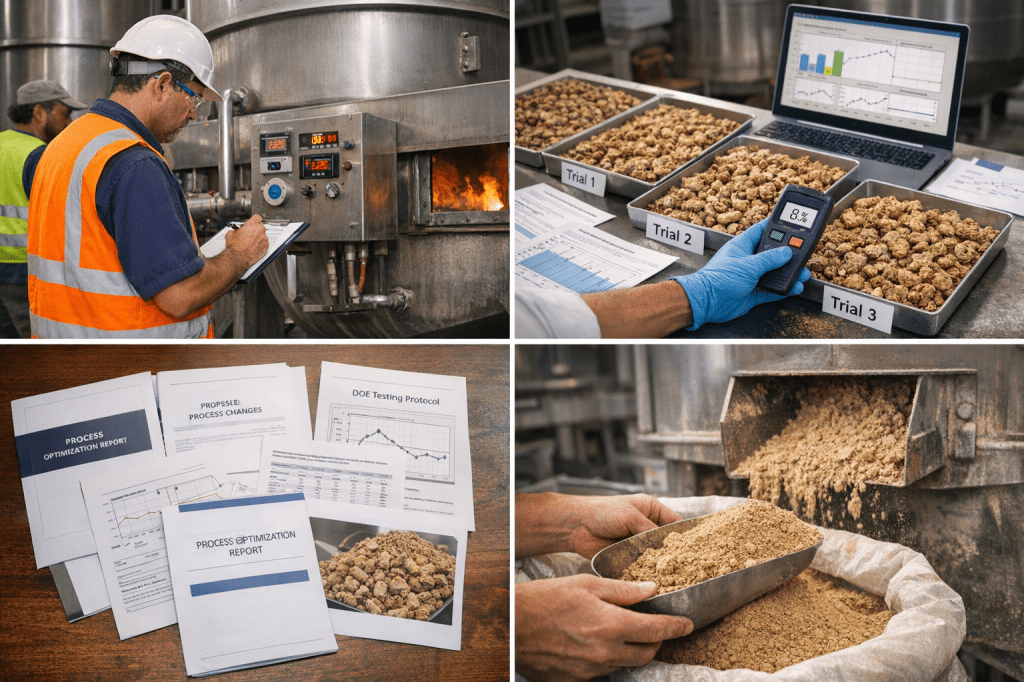
I was engaged by a Pacific Island producer to optimise their kava root drying operation using a gas-fired fluid bed dryer (FBD).
The objective was to achieve a controlled final moisture content that minimised microbial risk while preserving flowability and grindability for downstream milling.
Following a site visit, I conducted a comprehensive review of facility layout, dryer design, and historical process data.
Key sources of variability were identified including,
- Uneven air distribution within the FBD,
- Inconsistent raw root sizing prior to drying,
- And the absence of standardised process controls.
Over a two-day on-site engagement, I executed six experimental production batches under a modified drying regime.
Trials were structured using a Design of Experiments (DOE) methodology in Minitab, with controlled adjustments to inlet temperature ramp profiles, airflow velocity, and batch loading density.
These changes significantly improved drying uniformity and overall process efficiency.
Post-trial statistical analysis confirmed consistent moisture levels within specification and improved product handling during milling.
The engagement concluded with delivery of three critical outputs:
- A findings report with full statistical analysis comparing baseline and optimised operations
- A detailed proposal outlining permanent process changes and operator work instructions
- A validated Minitab-based DOE testing protocol for ongoing process verification and optimisation
The project resulted in a more controlled, energy-efficient drying process and established a robust foundation for continuous improvement within the facility.
Authors Note: Wilson Prasad also known as user name muefatiaki1966 is trying to leverage his extensive experience within the industry to educate and invoke discussion for topics of interest.
 DeepDivers
Leave a comment