
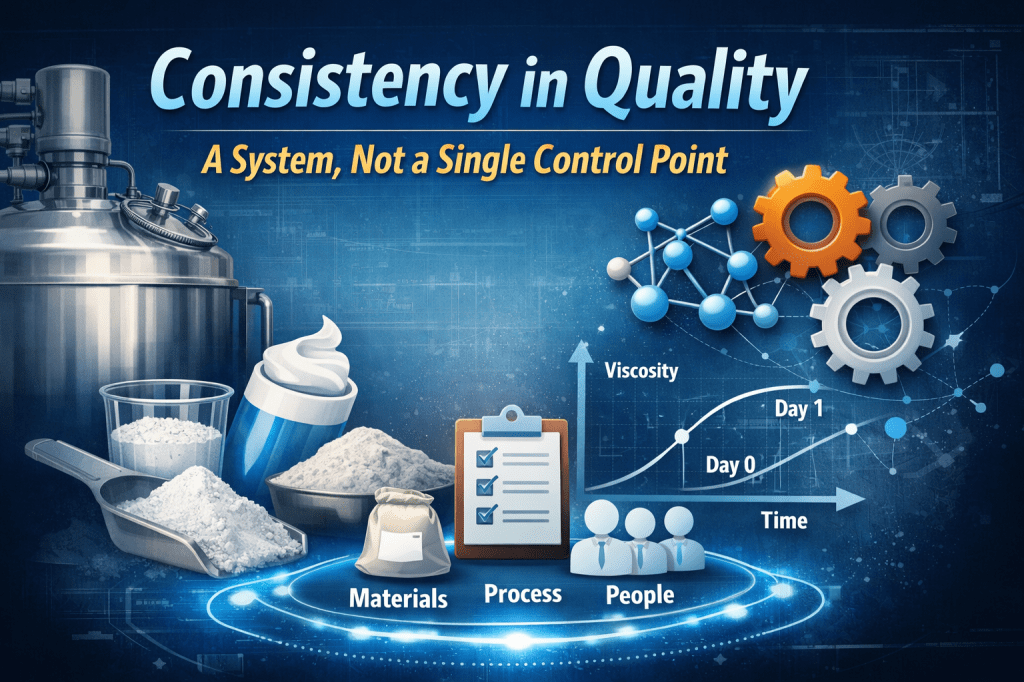
This is a case study from Wilson Prasad’s experience within the industry he is sharing to drive a learning exercise with his defined quote.
Consistency in quality is not achieved by a single control point, but by harmonizing materials, process, and people into one reproducible system. – Wilson Prasad, 2026
The Problem
On a high-volume toothpaste manufacturing line, several consecutive batches exhibited low viscosity immediately after manufacture.
However, after 24 hours at rest, the viscosity moved comfortably into specification.
This created a critical operational dilemma:
- Release immediately and risk OOS results
- Delay release and disrupt production flow
- Pause manufacturing until root cause was understood
The real challenge was not just meeting specification — it was achieving right-first-time viscosity at Day 0, without relying on time-dependent stabilization.
Define
Historical batch data was reviewed to identify patterns.
Out-of-trend viscosity results were correlated against:
- Raw material lots (particularly silica grades)
- Equipment configuration changes
- Production timeframes
- Operator shifts
This established that the issue was systemic… not random.
Measure
A structured rheology study was designed:
- Viscosity measured at 0, 24, 48, and 72 hours
- Silica characterized for:
- Particle size distribution
- Surface area and flow properties
- Moisture content
- Mixing practices documented directly on the manufacturing floor
- Shear rates and mixing energy reviewed against SOP targets
The goal was to move beyond a single-point QC result and understand viscosity development over time.
Analyse
The investigation revealed a classic structured-fluid behavior:
Toothpaste viscosity is governed by a time-dependent silica polymer network formation.
The hydrocolloid system (e.g., CMC or similar structuring polymers) interacts with hydrated silica particles to form a three-dimensional rheological network.
Key findings:
- Small shifts in silica texture and particle-size distribution altered hydration kinetics
- Variations in shear energy during mixing influenced network formation
- Minor moisture variation changed silica wetting efficiency
- Polymer activation time varied depending on mixing sequence
The result:
Day 0, Viscosity could be low even when final composition was correct.
The system simply had not yet completed its structural build.
This explained the 24-hour recovery.
Improve
The solution required harmonizing materials and process — not adjusting one variable.
Actions implemented:
- Tightened silica acceptance criteria (PSD, moisture, flow)
- Standardized mixing speed, shear profile, and hydration hold time
- Optimized structuring agent grade and ratio
- Locked mixing sequence to ensure proper polymer activation
- Reduced uncontrolled shear variability between operators
Control
Sustainability measures included:
- Updated work instructions and visual SOP guides
- Operator retraining on critical rheology drivers
- Routine viscometer calibration checks
- Temporary multi-timepoint viscosity monitoring until stability was proven
- Ongoing trending of silica lot performance
Once stabilized, Day 0 viscosity consistently landed within target range.
Production resumed without reliance on delayed stabilization.
Key Technical Insight
Viscosity was not a laboratory number.
It was the emergent property of a dynamic silica–polymer network forming under specific shear and rest conditions.
In structured fluids like toothpaste:
- Rheology is time dependent
- Thixotropy must be understood, not ignored
- Small raw material variation can amplify under shear
This was not a QC failure.
It was a systems interaction problem.
Takeaways:
1️⃣ Rheology Is a System Property
Viscosity sits at the intersection of raw material behavior, equipment capability, and operator execution.
2️⃣ Time Matters
For thixotropic systems, Day 0 and Day 1 results may reflect kinetic differences — not compositional failure.
3️⃣ DMAIC Still Works
Define–Measure–Analyse–Improve–Control remains one of the most effective frameworks for solving complex manufacturing variability — even in mature, high-volume processes.
Authors Note: Wilson Prasad also known as user name muefatiaki1966 is trying to leverage his extensive experience within the industry to educate and invoke discussion for topics of interest.
 DeepDivers
Leave a comment