
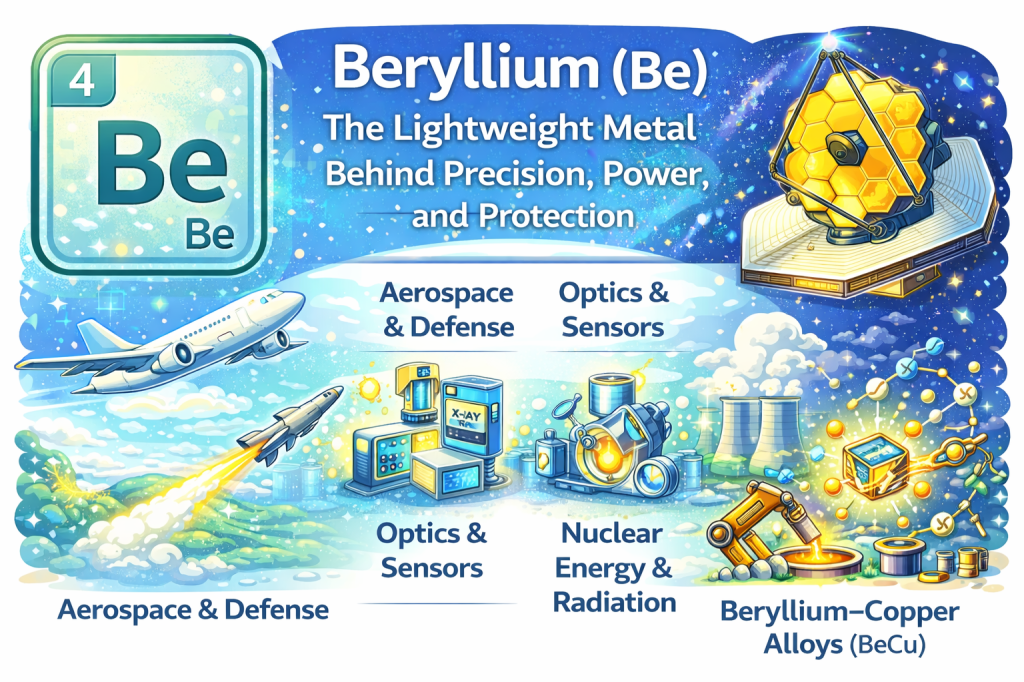
As part of The Periodic Table article series, this article serves as a revision of the previous article, and provides more extensive detail compared to the previous.
Overview
| Property | Value |
| Symbol | Be |
| Atomic Number | 4 |
| Atomic Mass | 9.0122 u |
| Group | 2 |
| Period | 2 |
| Classification | Alkali Earth Metal |
| Electron Configuration | 1s² 2s¹ |
| State at 25°C | Solid |
Beryllium is a rare but technologically critical element distinguished by an extraordinary combination of low density, high stiffness, and thermal stability.
Although classified as an alkaline earth metal, its chemistry and bonding behavior differ significantly from its group neighbors due to its small atomic radius and high charge density [1].
These unusual properties give beryllium one of the highest stiffness-to-weight ratios of any structural metal, making it indispensable in fields where precision and mass reduction are critical, such as aerospace engineering, nuclear systems, high-energy physics instrumentation, and optical technologies [2].
In modern advanced manufacturing, beryllium components are often used in environments where materials must withstand extreme temperatures, high radiation flux, and mechanical stress without distortion.
Discovery and Naming

Beryllium was discovered in 1798 by French chemist Louis Nicolas Vauquelin, who analyzed the minerals beryl and emerald and identified a previously unknown element in their composition [3].
The element was originally named glucinium (from the Greek glykys, meaning sweet) because several of its salts have a sweet taste.
However, due to potential confusion with glucose, the name beryllium was later adopted based on the mineral beryl, its primary natural source [4].
Pure metallic beryllium was not isolated until 1828, independently achieved by Friedrich Wöhler and Antoine Bussy through the reduction of beryllium chloride with potassium [5].
Atomic Structure and Isotopes
Beryllium atoms consist of:
- 4 protons
- 4 electrons
- Typically 5 neutrons (in the most stable isotopes)
Unlike most alkaline earth metals, beryllium forms predominantly covalent bonds rather than ionic ones.
This unusual behavior arises from its high ionization energy and strong polarization capability, which causes electron sharing rather than full electron transfer [1].
Notable chemical characteristics include:
- Amphoteric oxide (BeO)
- High melting point compounds
- Strong lattice energies
- Resistance to oxidation due to protective oxide layers
These features make beryllium compounds chemically closer to aluminium or metalloids than to magnesium or calcium.
Natural Occurrence and Extraction
Occurrence
Beryllium is relatively rare in the Earth’s crust, occurring at approximately 2–6 parts per million [6]. It occurs primarily in silicate minerals such as:
- Beryl (Be₃Al₂Si₆O₁₈)
- Bertrandite (Be₄Si₂O₇(OH)₂)
Gemstones including emerald and aquamarine are varieties of beryl colored by trace impurities.
Global Production
The majority of global beryllium production comes from:
- United States (Utah deposits)
- China
- Kazakhstan
- Brazil
Bertrandite deposits in Utah account for over 60% of global beryllium supply [7].
Extraction
Beryllium production typically involves:
- Ore crushing and beneficiation
- Chemical leaching to form beryllium hydroxide
- Conversion to beryllium fluoride
- Magnesium reduction to produce metallic beryllium
The resulting metal is often produced as powder or consolidated billets for industrial applications.
Application and Uses of Beryllium in Modern Technology
✈️ Aerospace and Defence Systems
Beryllium is widely used in aerospace engineering because it combines:
- High stiffness
- Low density
- Exceptional dimensional stability
Applications include:
- Satellite structural components
- Missile guidance systems
- Aircraft inertial navigation systems
- Space telescope mirrors
One of the most prominent examples is the James Webb Space Telescope, whose mirrors are made from gold-coated beryllium because the metal maintains its shape even at cryogenic temperatures near 40 K [8].
🔭 Optics, Sensors, and Precision Instruments
Beryllium is particularly valuable in optical and radiation systems because it is:
- Transparent to X-rays
- Non-magnetic
- Highly stable dimensionally
Applications include:
- X-ray tube windows
- Synchrotron beamline components
- Particle detector housings
- Precision gyroscopes and accelerometers
In X-ray spectroscopy, thin beryllium windows allow radiation to pass through while maintaining vacuum integrity [9].
⚛️ Nuclear Energy and Radiation Systems
Beryllium plays an important role in nuclear systems due to its neutron interactions.
It can act as:
- Neutron reflector
- Neutron moderator
- Neutron multiplier
When bombarded with alpha particles, beryllium can produce neutrons through the reaction:
This property is used in:
- Neutron sources
- Nuclear reactor cores
- Fusion reactor blanket materials [10]
ITER and other experimental fusion reactors are investigating beryllium for plasma-facing components.
🧪 Beryllium-Copper Alloys (BeCu)
Beryllium copper alloys contain 0.5–3% beryllium and combine remarkable mechanical properties:
- High tensile strength
- Excellent electrical conductivity
- Non-sparking characteristics
- High fatigue resistance
These alloys are widely used in:
- Electrical connectors
- Springs and switches
- Aerospace electronics
- Oil and gas drilling tools
Because they do not produce sparks, BeCu tools are essential in explosive environments such as refineries and mines [11].
🚀 Advanced Manufacturing & Emerging Uses
New applications of beryllium include:
- Precision semiconductor equipment
- High-frequency communication components
- Additive manufacturing powders
- Defense-grade electronics
- Quantum sensing devices
Materials scientists are also exploring beryllium matrix composites for next-generation spacecraft structures.
🌿 Health, Safety, and Environmental Considerations
Despite its technological advantages, beryllium presents serious occupational health risks.
Inhalation of beryllium dust can cause:
- Chronic Beryllium Disease (CBD)
- Lung inflammation
- Immune sensitization
CBD is a granulomatous lung disease caused by immune reaction to beryllium exposure [12].
Because of this risk:
- Strict workplace exposure limits are enforced
- Processing occurs in controlled environments
- Protective equipment and filtration systems are required
Solid beryllium components pose minimal risk once fully manufactured.
⚠️ Strategic and Supply Chain Importance
Beryllium is classified as a critical mineral by several governments due to:
- Limited global production
- Concentrated supply chains
- Essential roles in defense and aerospace industries
Substitutes often fail to replicate beryllium’s combination of stiffness, thermal stability, and radiation transparency, making it difficult to replace in many high-performance systems [7].
🧠 Scientific and Technological Significance
Beyond its engineering applications, beryllium has played an important role in nuclear physics.
In 1932, experiments involving beryllium bombarded with alpha particles led James Chadwick to discover the neutron, fundamentally transforming atomic physics and nuclear science [13].
Thus, beryllium has contributed not only to modern technology but also to our understanding of atomic structure itself.
Related Elements
- Lithium (Li): Lightweight metal used in energy systems
- Magnesium (Mg): Structural lightweight metal
- Aluminium (Al): Widely used aerospace metal
References
[2] Beryllium Chemistry and Processing
[3] Analysis of Beryl and Emerald
[5] Isolation of Beryllium Metal
[6] Composition of the Continental Crust
[7] Mineral Commodity Summary: Beryllium
[8] James Webb Space Telescope Mirror Technology
[9] X-Ray Fluorescence Spectrometry
[10] Nuclear Engineering
[12] Beryllium Disease
[13] The Possible Existence of a Neutron
Authors Note: Eddy Xu is trying to express his interest in STEM and provide educated articles to allow readers from all ages to learn science and tech. He has a strong passion to develop new learning methods to bridge the gap between education and industry practice in his journey.
 DeepDivers
Leave a comment