
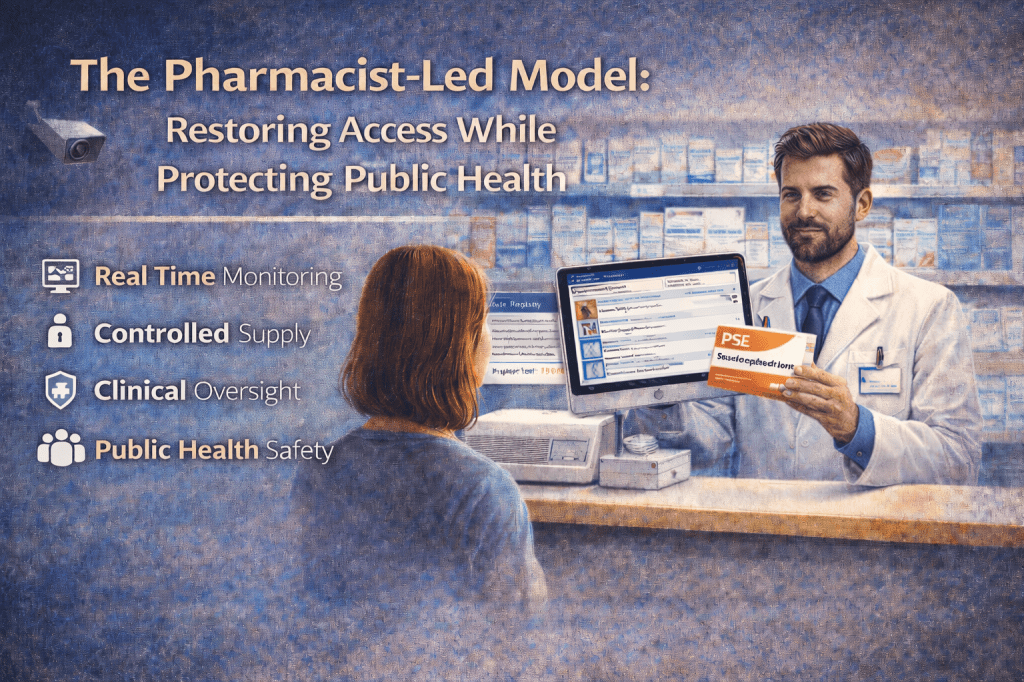
Continuing on from the previous article.
Public health policy often struggles to reconcile two legitimate objectives: “access to effective medicines” and “prevention of misuse or diversion“.
Pseudoephedrine (PSE) sits directly at this intersection.
Pseudoephedrine remains one of the most effective oral decongestants available, with controlled trials demonstrating significant reductions in nasal airway resistance and congestion compared with placebo [1, 2].
At the same time, the compound can be diverted for illicit methamphetamine production, which led to widespread regulatory restrictions in the mid-2000s [3].
However, modern pharmacy practice has evolved dramatically since those early policy responses.
Real-time monitoring systems, electronic recording requirements, and structured professional decision-making frameworks now allow pharmacists to manage medicines with misuse potential in a controlled clinical environment.
This raises a policy question increasingly discussed internationally:
Can pharmacist-led supply models simultaneously preserve public-health safeguards and restore access to effective medicines?
Evidence suggests the answer may be yes.
1) The Evolution of Pharmacist-Controlled Medicines
Modern medicines regulation recognises that not all drugs require the same level of control.
In Australia, this is reflected in the Poisons Standard (SUSMP) scheduling system, which stratifies medicines according to risk and required professional oversight [4].
Schedule 3 medicines (Pharmacist Only Medicines) occupy a unique regulatory position:
- Available without a prescription
- But only supplied after pharmacist assessment
- Stored behind the counter
- Not available through unrestricted retail access
This model recognises pharmacists as clinical gatekeepers, capable of assessing therapeutic need, screening for contraindications, and preventing inappropriate use.
Pseudoephedrine historically operated within this framework before diversion concerns prompted additional restrictions.
The compound was widely used because of its reliable pharmacological mechanism: stimulation of α-adrenergic receptors causes vasoconstriction in nasal mucosa, reducing swelling and congestion [5].
Importantly, the pharmacist-controlled medicine category exists precisely for medicines that:
- Have clear therapeutic value
- Require clinical judgement before supply
- Carry potential safety or misuse considerations
Pseudoephedrine fits this category closely.
2) The Modern Pharmacy Monitoring Environment
When pseudoephedrine diversion first became a policy concern, pharmacists had limited tools to detect suspicious purchasing patterns.
Today the situation is fundamentally different.
Australia now uses real-time monitoring systems, the most prominent being Project STOP, an electronic database that records pseudoephedrine sales and alerts pharmacists to potential misuse patterns [6].
Project STOP enables pharmacists to:
- Verify previous purchases across pharmacies
- Identify “pharmacy shopping” behaviour
- Document denied sales
- Generate intelligence for law-enforcement collaboration
The system operates as a preventive diversion control mechanism, disrupting the initial acquisition of pseudoephedrine for illicit drug production [7].
Evidence suggests the program has had measurable impact.
Research examining its implementation found that monitoring programs helped prevent pseudoephedrine diversion and were associated with reductions in clandestine laboratory activity in some jurisdictions [8].
Many jurisdictions now require pseudoephedrine sales to be recorded electronically at the time of supply, creating a national traceability framework [9].
This represents a significant shift from the regulatory environment that existed when restrictions were first introduced.
3) Clinical Assessment: The Pharmacist as a Frontline Clinician
A pharmacist-led model is not simply a retail transaction.
It is a structured clinical interaction.
When supplying pseudoephedrine, pharmacists typically evaluate several clinical parameters:
Symptom assessment
Pharmacists determine whether the patient’s symptoms are consistent with conditions such as:
- Viral upper respiratory infection
- Allergic rhinitis
- Sinus congestion
Pseudoephedrine’s efficacy in these conditions has been demonstrated in randomized trials measuring both subjective symptom relief and objective nasal airway resistance [1, 10].
Contraindication screening
Pseudoephedrine can cause sympathomimetic effects, so pharmacists must screen for conditions such as:
- Uncontrolled hypertension
- Cardiovascular disease
- Hyperthyroidism
- Certain drug interactions (e.g. MAO inhibitors)
Duration of symptoms
Persistent or severe symptoms may indicate:
- Bacterial sinusitis
- Structural airway problems
- Other conditions requiring medical referral
In these cases pharmacists direct patients to medical care rather than supplying medication.
This triage role is increasingly recognised as an important component of primary healthcare access.
4) Controlled Supply Conditions
Pharmacist-led models rely on structured safeguards rather than unrestricted access.
These safeguards may include:
Pack-size limits
Limiting the quantity supplied reduces the potential for diversion.
Supply frequency controls
Electronic monitoring systems allow pharmacists to enforce intervals between purchases.
Identity verification
Pharmacists may request identification when recording sales in monitoring databases.
Real-time recording
Every supply event is documented in electronic systems such as Project STOP.
This multi-layered approach is sometimes described in regulatory literature as “third-party policing”, where healthcare professionals participate in crime-prevention frameworks while delivering clinical care [7].
5) Evidence that Pharmacist Monitoring Works
Evidence from Australian policy evaluations indicates that pharmacist-based monitoring programs can meaningfully disrupt diversion networks.
Studies evaluating Project STOP found that the system helped pharmacists detect suspicious purchase patterns and deny sales linked to potential methamphetamine production [8].
The approach works because diversion typically requires repeated small purchases across multiple pharmacies.
Real-time monitoring breaks this pattern by allowing pharmacists to identify cumulative purchases in a shared database.
This transforms pharmacists from passive retailers into active diversion-prevention partners.
6) International Precedent for Pharmacist-Led Supply
Pharmacist-controlled medicine models are expanding globally.
Several countries rely on pharmacists to manage access to medicines that:
- Have therapeutic value
- Require clinical screening
- Carry potential misuse risks
Examples include:
- Emergency contraception
- Short-acting bronchodilators
- Naloxone supply programs
- Smoking cessation pharmacotherapy
These models demonstrate that professional oversight can balance access with safety.
Pharmacists are among the most accessible healthcare professionals, making them particularly effective for managing common conditions such as respiratory infections and allergic rhinitis.
7) Public-Health Advantages of Pharmacist-Led Models
From a health-system perspective, pharmacist-managed supply models offer several benefits.
Improved treatment effectiveness
Patients gain access to medicines with demonstrated efficacy rather than less effective alternatives. Clinical trials repeatedly demonstrate pseudoephedrine’s ability to improve congestion outcomes compared with placebo [1, 2].
Reduced healthcare system burden
Community pharmacies handle millions of minor illness consultations annually, reducing unnecessary general practitioner visits.
Early detection of serious illness
Pharmacists can identify red-flag symptoms requiring medical referral.
Ongoing diversion monitoring
Real-time databases maintain visibility over pseudoephedrine distribution patterns.
Together these outcomes support broader healthcare goals of strengthening primary care and improving resource allocation.
8) Aligning Pharmacist Supply with Regulatory Principles
Australia’s Scheduling Policy Framework requires regulators to balance multiple factors when determining medicine access:
- Toxicity and safety profile
- Potential for abuse or diversion
- Extent of therapeutic benefit
- Public-health impact
A pharmacist-led pseudoephedrine model addresses these criteria directly.
The model:
- Maintains professional oversight
- Enforces monitoring requirements
- Preserves diversion controls
- Restores access to effective therapy
Rather than weakening regulation, this approach uses regulation more intelligently.
Conclusion: Trusting the System Built to Protect Medicines Use
Pseudoephedrine presents a classic public-health trade-off: strong therapeutic benefit coupled with potential misuse.
The modern pharmacy environment now includes tools that did not exist when the original restrictions were implemented:
- Real-time monitoring systems
- Mandatory recording requirements
- Integrated professional decision support
- Robust pharmacist practice standards
These systems transform pharmacists into clinical gatekeepers and diversion-prevention partners.
The question for policymakers is therefore not whether pseudoephedrine carries risk.
It is whether a mature pharmacist-led system is capable of managing that risk while restoring access to an effective medicine.
References
[4] The Poisons Standard (the SUSMP)
[5] The Pharmacological Basis of Therapeutics
[9] Requirements for recording pseudoephedrine sales
Authors Note: Wilson Prasad also known as user name muefatiaki1966 is trying to leverage his experience working on products containing PSE in Australia for over 20 years and would like to express his interest and concern of PSE based products in Australia.
 DeepDivers
Leave a comment