
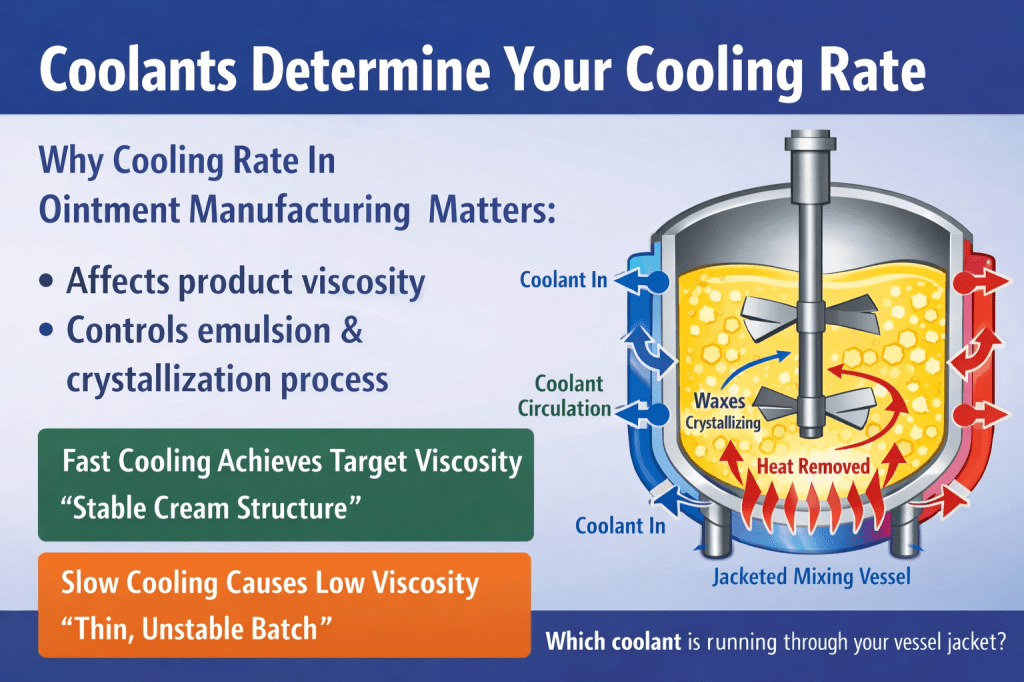
From an operations standpoint, cooling is not just a utility… it is a critical part of the process design.
In jacketed manufacturing vessels used for creams, ointments, and emulsions, the cooling system is responsible for removing heat from the batch at a controlled rate.
The speed at which this heat is removed determines how quickly the product moves through its structural formation phase.
In practical terms, cooling performance is governed by four operational variables.
1) Coolant Type and Heat Removal Capacity
Different coolants have very different abilities to absorb heat.
Common cooling media used in pharmaceutical manufacturing include:
- Chilled water
- Glycol-water mixtures
- Thermal oils
Water-based systems generally remove heat faster because they have:
- Higher heat capacity
- Better thermal conductivity
- Lower viscosity
Thermal oils, while excellent for high-temperature heating, remove heat more slowly.
If a site switches from a water-based coolant to a thermal oil system, cooling time can change dramatically.
From an Engineering perspective, this means that utility selection directly affects process performance.
2) Jacket Flow Rate and Pump Capacity
Even if the coolant type is identical, cooling performance can vary depending on how quickly the coolant flows through the vessel jacket.
Higher flow rates improve cooling because they:
- Increase turbulence inside the jacket
- Improve heat transfer from the vessel wall
- Prevent coolant temperature rise during circulation
If pumps are undersized or flow distribution is poor, cooling efficiency drops.
This is why two facilities with identical vessels can experience very different cooling profiles.
3) Coolant Temperature Control
The temperature difference between the product and the coolant determines how quickly heat leaves the batch.
For example:
- Product temperature: 75°C
- Coolant temperature: 10°C
This large temperature difference allows heat to be removed quickly.
However, if the coolant system only delivers 20–25°C, the driving force for heat transfer drops significantly.
From an operations perspective, this means chiller capacity and setpoints matter just as much as the coolant itself.
4) Heat Transfer Area and Vessel Design
The vessel jacket is the physical interface where heat exchange occurs.
Cooling performance depends on:
- Jacket surface area
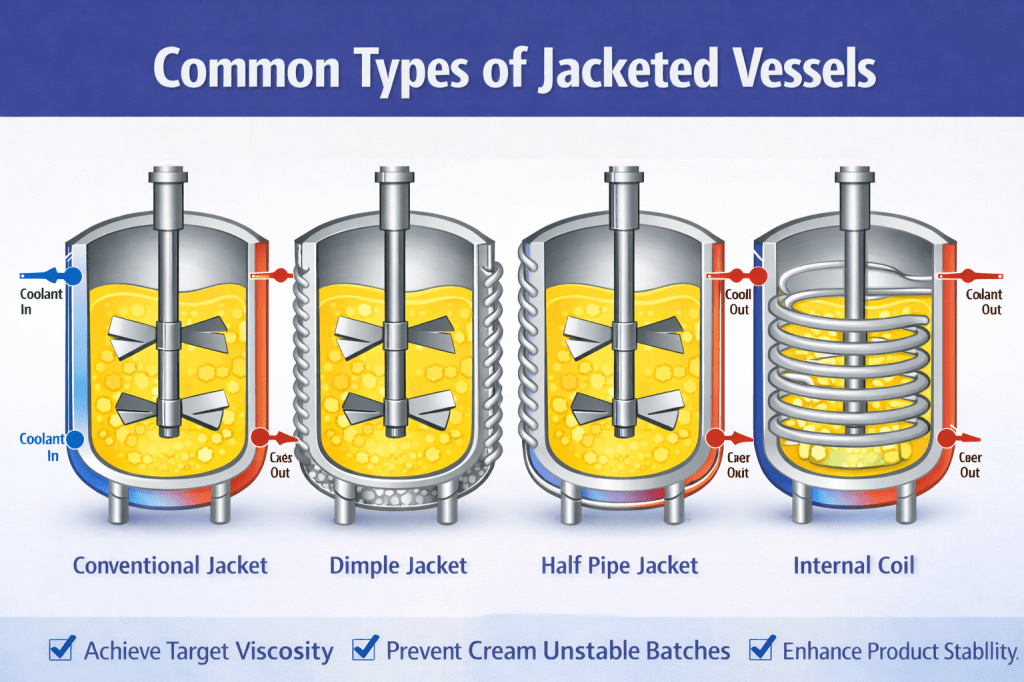
- Jacket design (i.e. dimple jacket, half-pipe coil, conventional jacket)
- Internal mixing efficiency
If mixing is insufficient, hot product near the vessel wall cools quickly while the bulk of the batch remains warm.
This creates uneven cooling and inconsistent product structure.
For this reason, agitator speed during cooling is often just as important as coolant flow.
Why Operations Teams Must Pay Attention to Cooling?
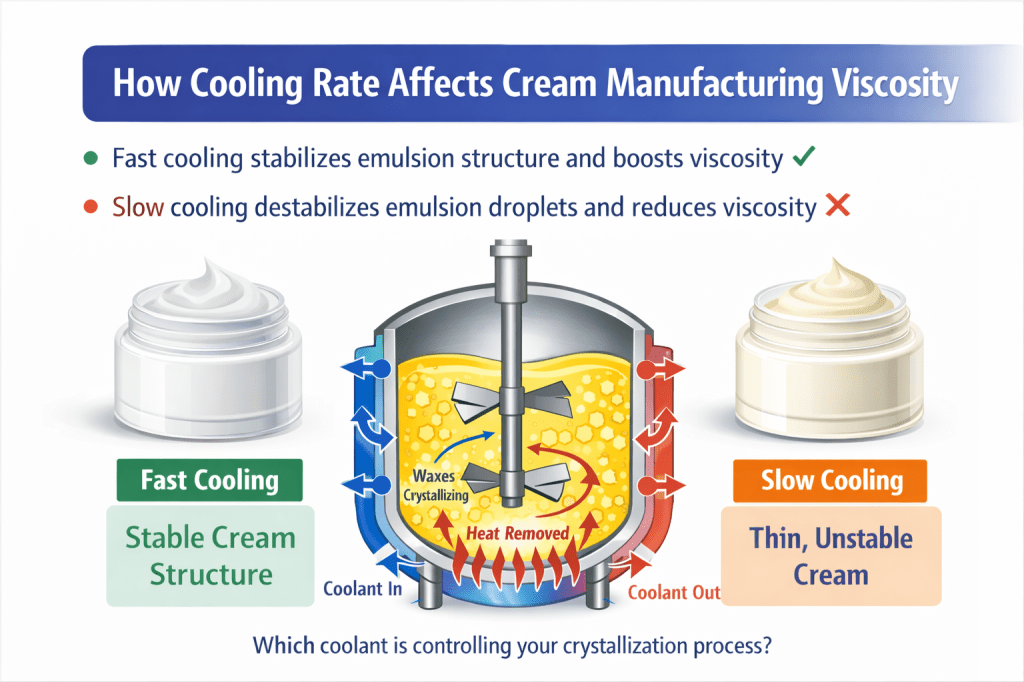
In cream and ointment manufacturing, cooling is not simply the final step in the process— it is the stage where the product structure actually forms.
During cooling:
- Waxes crystallise
- Fatty alcohol networks develop
- Emulsion droplets become immobilised
- Viscosity builds
If cooling occurs too slowly, these structures form differently, which can lead to:
- Lower viscosity
- Poor product body
- Instability over time
From an operations perspective, this means cooling rate should be treated as a critical process parameter (CPP).
The Practical Engineering Lesson
One of the most common mistakes during technology transfers is assuming that utilities behave the same at every site.
In reality, cooling systems can vary significantly between facilities due to:
- Different coolant media
- Different chiller capacities
- Different jacket designs
- Different pump flow rates
Replicating the recipe is not enough.
To replicate the process, engineers must replicate the cooling curve.
And sometimes, the difference between a failed batch and a successful one comes down to something as simple as:
Which coolant is circulating through the jacket?
Authors Note: Wilson Prasad also known as user name muefatiaki1966 is trying to leverage his experiences within the manufacturing and production industry to educate and invoke discussion in regards to topics of interest.
 DeepDivers
Leave a comment