
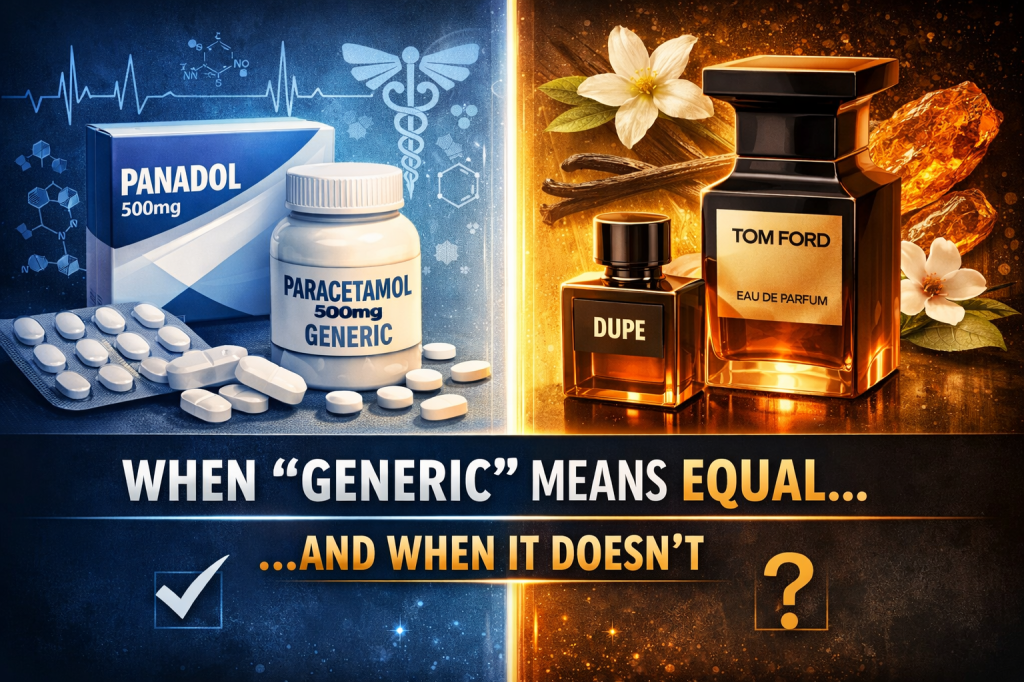
Walk into any pharmacy or fragrance retailer today and you will see the same pattern: a premium original sitting beside a cheaper alternative.
On the surface, generic paracetamol and a “dupe” of a Tom Ford fragrance can look like the same value proposition — pay less, get almost the same thing.
But they are not the same kind of substitute.
In fact, they sit at opposite ends of the equivalence spectrum.
1) In medicines, “generic” is a promise
In medicines, “generic” is not a casual marketing term. It is a regulatory concept.
In Australia, a generic medicine must contain the same active ingredient as the reference product, and applicants generally need to demonstrate bioequivalence against an Australian reference brand.
In simple terms, the generic must show that the active ingredient is absorbed by the body to the same extent over the same period of time as the original.
That is why a 500 mg generic paracetamol tablet and a 500 mg branded tablet such as Panadol are expected to deliver the same therapeutic effect for pain and fever relief when used as directed.
The excipients may differ — coatings, fillers, binders, flavours — but the active molecule is the same, and the regulatory system is designed to ensure no clinically meaningful loss of performance.
Regulators such as the TGA and FDA both frame generic approval around pharmaceutical sameness, quality standards, and bioequivalence.
That does not mean every tablet feels identical in the hand or mouth. A branded tablet may be smoother to swallow, dissolve a little differently, or use different packaging and flavour systems.
But those differences do not change paracetamol’s intrinsic analgesic effect when the products meet approval requirements.
So in OTC analgesia, “generic” is designed to mean one thing: clinically equivalent, at a lower price.
2) In perfumery, there is no true generic
Now move to the fragrance counter.
Here, consumers often see an original luxury scent beside an “inspired by,” “equivalent,” or “dupe” fragrance. It is tempting to treat that relationship as if it were the same as brand versus generic medicine.
It is not.
Perfumes are regulated very differently from medicines. There is no concept of fragrance “bioequivalence,” no requirement for a dupe to prove sensory sameness over time, and no obligation to replicate the original formula note-for-note.
In cosmetics regulation, fragrance blends are generally declared simply as “parfum” or “aroma,” with some allergen disclosure rules layered on top, rather than being assessed through a therapeutic equivalence framework.
That matters because a luxury fragrance house is not merely selling a smell category. It is selling a composed formula, ingredient selection, technical performance, consistency, aesthetic identity, and brand meaning.
A dupe may aim to resemble the opening impression of that scent, but it is not required to reproduce the full arc of development, projection, wear, or material quality.
So while generic paracetamol is meant to be equal in clinical function, a fragrance dupe is usually meant to be similar in impression.
That is a very different promise.
3) Ingredients and seasonality: synthetic certainty Vs. natural nuance
Paracetamol is built around a single defined active molecule manufactured to tight quality specifications. Whether sold in premium packaging or as a private-label product, the active ingredient is chemically the same.
From a manufacturing standpoint, that gives an enormous advantage in consistency: same molecule, same dose, same mechanism, same therapeutic target.
Perfumery is far more complex.
A fragrance may contain naturals, nature-identical materials, and fully synthetic aroma chemicals blended to create top notes, heart notes, base notes, diffusion, and longevity. Many natural fragrance materials come from agricultural systems and can vary with origin, harvest conditions, extraction method, and regulatory status.
On top of that, the fragrance industry operates within evolving safety frameworks, including IFRA Standards and cosmetics rules in different jurisdictions, which can restrict or limit how certain ingredients are used.
That complexity is one reason originals and dupes diverge. A lower-cost alternative may successfully mimic the first spray, but matching the full sensory architecture of a prestige fragrance — especially over several hours of wear — is a much harder technical challenge.
Cost pressure also pushes many dupes toward more accessible material choices rather than exact olfactory construction.
4) A tale of two studies
If we designed a study comparing generic paracetamol with the original brand, we would focus on pharmacokinetics and therapeutic effect. We would ask whether blood exposure falls within accepted bioequivalence limits and whether pain relief is clinically comparable.
That is exactly the sort of framework medicines regulation is built around.
If we designed a study comparing a Tom Ford fragrance with a dupe, the methods would be completely different.
We might use GC-MS to compare composition, trained panels to evaluate similarity across opening, heart, and dry-down, consumer testing for preference and perceived luxury, and wear trials to assess projection and longevity over time. We would not be studying “equivalence” in the pharmaceutical sense. We would be studying resemblance, performance, and value perception.
And that is the key distinction.
Generic medicines are engineered and regulated to be equivalent. Fragrance dupes are engineered to be approximations.
5) What this means for self-care and beauty leaders
For healthcare professionals, pharmacists, and OTC manufacturers, the message is straightforward: appropriate substitution to approved generics can improve affordability and access without compromising expected clinical outcomes.
Public education should continue to reinforce that, for medicines like paracetamol, the active ingredient and intended effect are what matter most, not the logo on the box.
For fragrance and beauty brands, the competitive reality is different. Dupes are unlikely to disappear, because they appeal to price-sensitive consumers looking for the vibe of a luxury scent at a lower cost.
Original houses therefore need to compete where imitation is weakest: formulation craft, performance, safety assurance, consistency, regulatory discipline, packaging, storytelling, and emotional connection.
As consumers become more price-aware across every category, the phrase “generic versus original” will keep reappearing.
Our job as industry professionals is to explain when “generic” really means equal — and when it simply means similar, at a different price point.
Whats more to come?
We will dive deeper into this content within the upcoming months in the new series, “
Authors Note: Wilson Prasad also known as user name muefatiaki1966 is trying to leverage his experiences within the manufacturing and production industry to educate and invoke discussion in regards to topics of interest.
 DeepDivers
Leave a comment